Releases
WADA’s World Conference on Doping in Sport focuses on revised World Anti-Doping Code and International Standards

Today, the World Anti-Doping Agency’s (WADA’s) sixth World Conference on Doping held a number of important sessions that set the tone for a landmark week and charted the path for a strengthened Global Anti-Doping Program.
The first session, titled ‘From Katowice to Busan and Beyond’, featured past and present anti-doping leaders, including current WADA President, Witold Bańka – who delivered the keynote address – as well as WADA’s Founding President, Richard Pound (1999-2007); former WADA President, Sir Craig Reedie (2014-2019); and WADA Athlete Council Chair, Ryan Pini. Moderated by renowned journalist, broadcaster, author and podcaster, Tracey Holmes, the session reflected on the journey since the 2019 World Conference in Katowice, Poland, and on the path forward for the global anti-doping community.
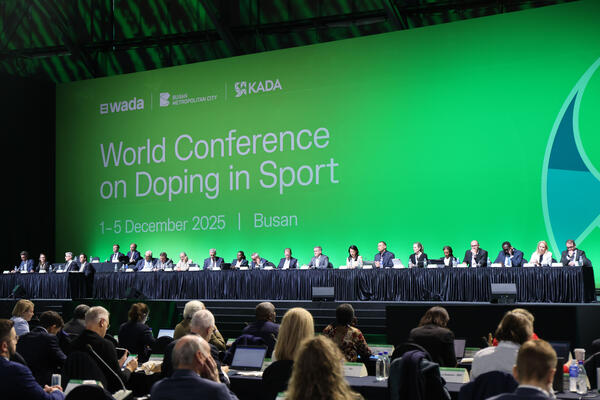
Mr. Bańka said: “WADA and the anti-doping community have taken great strides, not only since the last World Conference, but throughout its history. Over the past 26 years, global anti-doping has undergone a transformation that few could have predicted when WADA was born in 1999. What was once a fragmented landscape – with different rules, different laws, different expectations – has become a harmonized system built on shared responsibility between governments and the sport movement. Some doubted this model would last, but it has proven to be durable and essential to the success of the entire global anti-doping system.
“Today we face new pressures: rapid technological change, expanding financial incentives, and increasing geopolitical tensions. However, these issues do not stem from the rules. The World Anti-Doping Code and International Standards are robust and fit for purpose. The challenges arise when the rules are not applied consistently. Where implementation is strong, trust grows. On 5 December, we will adopt the revised World Anti-Doping Code and International Standards – the result of two years of global consultation. Its effectiveness will depend not just on the text, but on our collective commitment to enforce it fairly and without hesitation. I am confident that those here in attendance and stakeholders around the world will do just that.”
The second session of the day gave an overview of the proposed changes contained within the revised Code and Standards which will include:
- Additional focus on Human Rights;
- Expansion of protections for minors and protected persons;
- Increased responsibility of Athlete Support Personnel;
- Introduction of Independent Review Experts;
- A more flexible approach to sanctioning;
- Expansion of the definition of “Contaminated Source”;
- Expanded Appeal Rights for Athletes;
- A number of changes to further limit the risk for bias in the Doping Control Process;
- Consent required for publication of no-fault cases; and
- A number of new obligations for anti-doping organizations.
In the afternoon, 52 delegates from around the world had the opportunity to intervene publicly on the current status of anti-doping and on the revised Code and Standards, while another nine submitted written interventions. All interventions will be published on the World Conference website shortly. Many delegates lauded the final draft version of the Code, emphasizing its benefits for both athletes and Anti-Doping Organizations worldwide, and suggested ways that the global anti-doping system could be further improved. This session also provided an opportunity for delegates to present their aspirations for the system that could be reflected in the Busan Declaration that will be presented on 5 December for endorsement by Conference participants.
Tomorrow, the Conference kicks off with a session focused on the Human Rights and Anti-Doping Framework, where athletes’ representatives and experts will discuss how the World Anti-Doping Program protects athletes’ rights and how they can be further strengthened. Thereafter, there will be a number of sessions that will take a deeper dive into each International Standard; followed by a session dedicated to the journey towards the 2027 Code and Standards, including looking at the successful athlete-centered consultation carried out earlier this year. To wrap up the day, participants will hear about the extensive support that WADA will provide stakeholders so they can successfully implement the Code and Standards for the benefit of athletes worlwide.
About the World Conference
Organized with the generous support of the Korea Anti-Doping Agency and the City of Busan, the World Conference is gathering athletes and around 1,500 representatives from the Sport Movement, Governments, National and Regional Anti-Doping Organizations, laboratories, service providers, researchers, and the media – all groups that are part of the collaborative worldwide movement for doping-free sport. As outlined in the official program, the Conference will conclude on 5 December with the 2027 World Anti-Doping Code and International Standards being approved by WADA’s Foundation Board and Executive Committee respectively.
Note to editors:
Photos from the World Conference are available here. These rights can be reproduced free for editorial purposes, with the appropriate credit (WADA).